
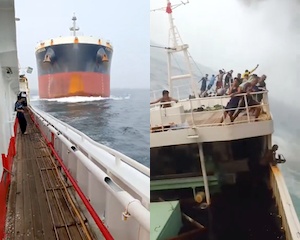
How did it come to this? A Panama-flagged cargo ship and a Chinese fishing vessel collided off the coast of Singapore. This video was filmed by a crew member of the fishing vessel. It’s hard to tell who was at fault from this angle, but it seems like the fishing vessel could have at least made a move to avoid the collision.
Video
Video
The Reality of “Flag of Convenience” Practices as Revealed by Collision Accidents
The Singapore Strait is a major global maritime chokepoint traversed by approximately 100,000 vessels annually; a Traffic Separation Scheme (TSS) is in place to prevent accidents. Nevertheless, academic studies estimate that ship collisions occur at a rate of about 1.75 per year in the strait’s shipping lanes, suggesting that incidents like this one are by no means rare.
According to reports from specialized maritime media, the cargo ship involved was an 80,000-deadweight-ton class bulk carrier; it was registered in Panama, owned by a Japanese entity, and managed by a Chinese company. Following the collision, the vessel reportedly continued westward at 10 knots for approximately two hours before stopping, turning back toward the scene of the accident, and dropping anchor. There were no reports of injuries, and the fishing vessel reportedly managed to reach a nearby wharf under its own power while transmitting AIS signals.
It is not unusual for a cargo ship to be registered in Panama, as was the case here. “Flag of convenience” registration—whereby ships are registered in foreign countries to take advantage of tax benefits or exemptions from requirements to employ domestic crew—is a common practice in the global shipping industry; Panama accounts for the largest share of the world’s fleet at 17.7%. Among vessels operated by Japanese ocean-going shipping companies, that figure rises to 61.3%.


Comments