
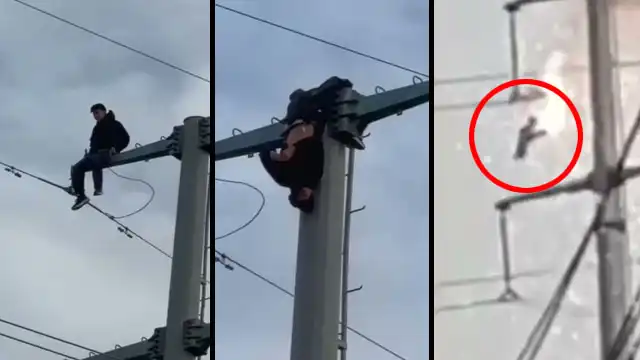
Depression accompanied by the drive to take action.
Shocking footage capturing a fatal acrobatic stunt in China—a case of suicide where the individual deliberately chose a highly visible public location. It became a hot topic on social media, with people speculating that the person belonged to the “Guabi Qingnian” (wall-hanging youth) demographic—a slang term for young people who have failed to adapt to society and are merely existing.
Video
The “Wall-Hanging Youth”: The Discrepancy Between Job Market Struggles and Suicide Statistics
The footage in question has drawn comparisons on social media to the “Gua Bi” (literally “hanging on the wall”) youth—a term referring to young people in China who lack stable employment or housing and subsist on day labor and cheap, cramped living quarters. While the previously popularized “Tang Ping” (lying flat) movement represented a voluntary withdrawal from competition, “Gua Bi” describes a more passive state of marginalization, where individuals have been pushed out of mainstream society due to setbacks such as employment failure. In fact, the unemployment rate for urban residents aged 16 to 24 (excluding students) hit 18.9% in August 2026—the highest level since current statistics began—far exceeding the overall unemployment rate of 5.3% for that month. The number of university and graduate school students graduating that year also reached a record high of 12.7 million, highlighting the reality that the difficulty in finding employment is concentrated among the younger generation.
On the other hand, while China’s overall suicide rate dropped by 64% between the 1990s and 2016—falling to a level low by global standards—peer-reviewed studies indicate a sharp rise in the suicide rate among 10- to 19-year-olds, climbing from 1.59 per 100,000 people in 2017 to 2.83 in 2021; thus, the trend among the youth has moved in the opposite direction in recent years.
Watch Next
 A high school student whose life has not yet begun commits suicide.
 Living expenses vanished into debt repayment; the man, enraged upon discovering the betrayal, forces a double suicide with his partner.
 Boyfriend finds out his girlfriend scammed him: “I’m gonna kill her and then kill myself” → terrifying video


Comments