
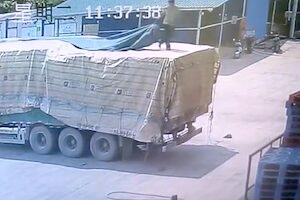
Did he step into a gap with his left foot after extending the line and turning around? This is security camera footage of a workplace accident filmed in China. He spins around and falls onto his back; while the specific frames don’t clearly show the exact moment of impact, it looks like he must have slammed the back of his head hard against the ground.
Video
The Origin of the Phrase “One Misstep Leads to Eternal Regret” and Chinese Workplace Accident Statistics
The phrase “a single misstep leads to eternal regret” (isshissoku senko no kon) cited in the post is believed to have originated from the expression “a single misstep leads to eternal ridicule” (isshissoku senko no shō), a lament attributed to Tang Bohu, a Ming Dynasty scholar implicated in a civil service examination scandal. Later, in a Qing Dynasty novel, the character for “ridicule” (shō) was changed to “regret” (kon); the phrase subsequently spread as a warning against momentary carelessness and remains frequently cited today in the context of workplace accidents.
In China, a system established by State Council administrative regulations classifies workplace accidents into four tiers based on the scale of the damage: “extraordinarily serious,” “serious,” “relatively serious,” and “general.” According to data released by the Ministry of Emergency Management, there were 19,884 industrial safety accidents and 18,261 fatalities nationwide in 2025—both figures representing a decrease from the previous year—with no “extraordinarily serious” accidents occurring throughout the year. Past records in the logistics and warehousing sectors include incidents where workers slipped and fell while securing tarpaulins over truck beds, indicating that falls associated with cargo handling operations can occur at various types of worksites, not just specific locations.


Comments