
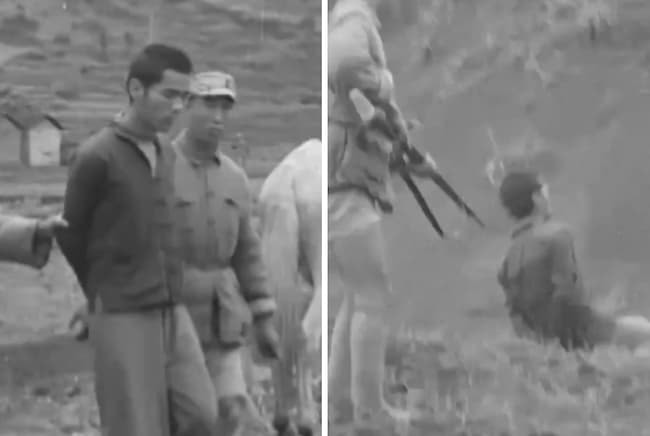
Footage has surfaced on an overseas “shock” website showing a Japanese individual—accused of being a spy—being shot to death by Chinese soldiers during the Second Sino-Japanese War (1937–1945). The video, which is currently drawing attention, includes scenes of the individual’s body being repeatedly kicked during the execution.
Video
The Execution of 4,000 “Traitors” and the Legal Vacuum Surrounding Plainclothes Combatants
While there is no verifiable documentation regarding the time or location of the execution scenes depicted in the footage—purportedly from the Second Sino-Japanese War—it is often difficult to identify “miscontextualized” misinformation, where authentic footage is presented within a different time or place. A similar phenomenon occurred during the 2024 Noto Peninsula Earthquake, when footage from past, unrelated disasters was erroneously circulated as if it were happening in the present.
During the Second Sino-Japanese War, the Chinese side frequently executed individuals suspected of being spies or collaborators with Japan—labeled as hanjian (traitors)—summarily and without trial under martial law. Following the Second Battle of Shanghai, dozens of people were executed daily, with the total reaching 4,000; in Nanjing, it is estimated that approximately 2,000 people were executed by firing squad by November 1937. During the air raids on Guangzhou in September 1937, more than 100 people were executed for alleged espionage within a single week, based solely on suspicions that they had used flashing lights to mark targets for the air strikes. Meanwhile, Article 23, Paragraph 2 of the Hague Convention (IV) denied combatant status—and thus the protections afforded to prisoners of war—to “plainclothes combatants” (bienyi bing) who did not wear uniforms and could not be distinguished from civilians. Legal scholars have debated the validity of this interpretation: Tatsusaku Tatsusaku argued that such individuals could be punished as serious wartime offenders, whereas Ikuhiko Hata maintained that executions carried out without a formal process to distinguish them from ordinary civilians could not be justified. Even the Japanese military, in its “Military Regulations for the Central China Area” established in December 1937, stipulated that the execution of plainclothes combatants required both a trial by a military tribunal and authorization from the commanding officer.


Comments